

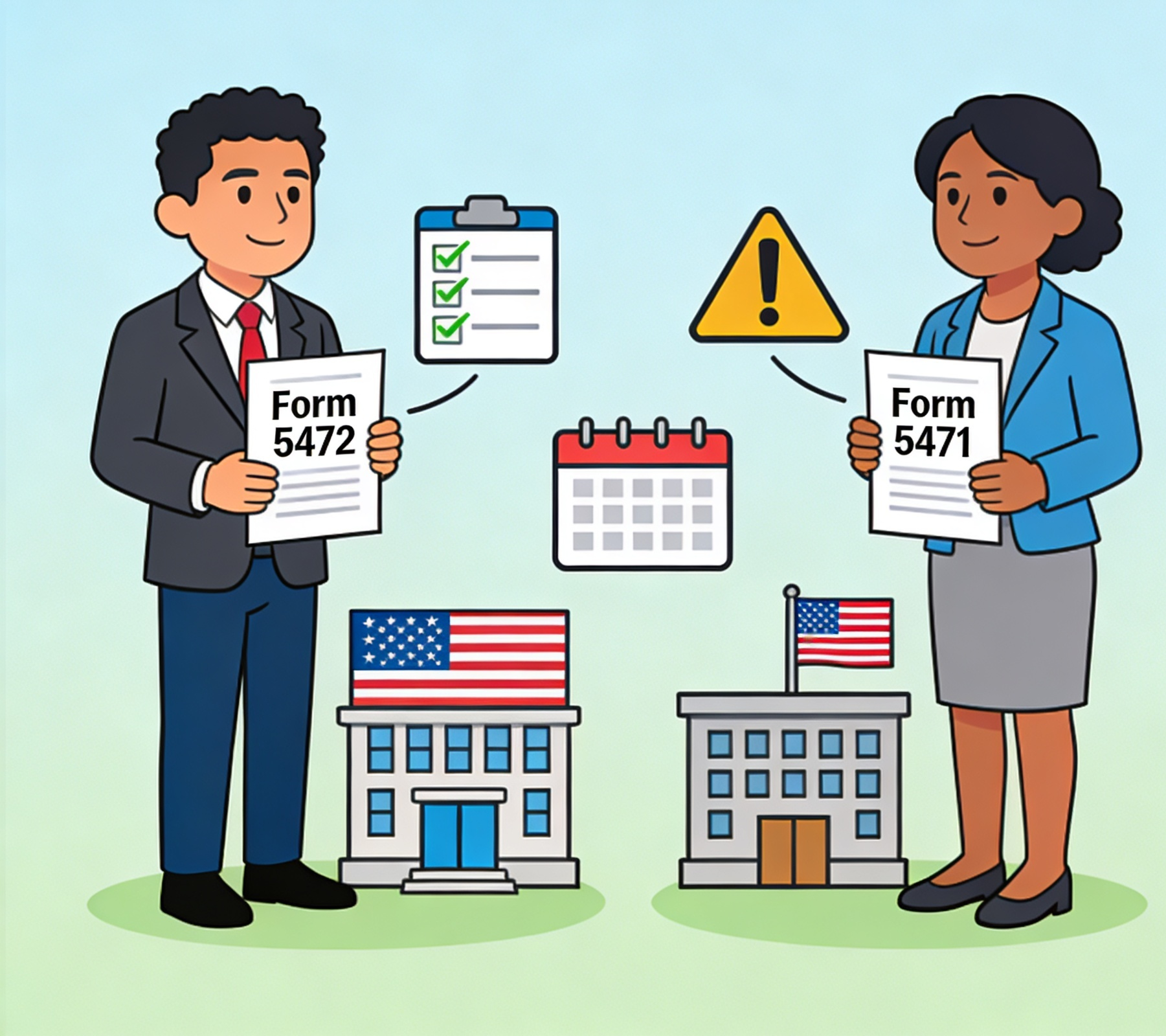
When a U.S. person or business owns a foreign entity, the tax issue is often disclosure, not just income. U.S. tax law requires detailed reporting and strict recordkeeping, even when there is little or no current U.S. tax due, and penalties for getting it wrong can be severe.
U.S. Businesses with Foreign Ownership: Form 5472
If a domestic corporation is at least 25% foreign‑owned, it is subject to special reporting and recordkeeping rules under I.R.C. § 6038A. That generally means:
- A U.S. corporation that is 25% or more owned (by vote or value) by a foreign person must file Form 5472 to report transactions with related foreign parties.
- The corporation must maintain records sufficient to substantiate the correct U.S. tax treatment of those related‑party transactions.
Failure to file Form 5472 or keep adequate records triggers a statutory penalty of 25,000 dollars per year, per required form, and the statute of limitations remains open until the failure is corrected. If the noncompliance continues after the IRS issues a notice, additional 25,000‑dollar penalties can apply for the same year. In other words, even small or low‑activity corporations cannot ignore these filings simply because there is “no tax due.”
Limited Relief for Small Corporations
Treas. Reg. § 1.6038A‑4(b)(2)(ii) provides a narrow “reasonable cause” relief for certain small corporations:
- The corporation has gross receipts of 20 million dollars or less.
- It has a limited U.S. presence and can show it genuinely lacked knowledge of the filing requirement.
- It responds promptly and fully once the IRS contacts it.
Even then, this relief is not automatic and only addresses penalties; it does not eliminate the underlying filing obligation. The message for small closely held corporations: you may have a path to penalty relief, but you still need to comply and be prepared to explain why you missed the filing in the first place.
U.S. Individuals and Owners of Foreign Corporations: Form 5471
For U.S. individuals and other U.S. persons who own foreign corporations, the rules get more complex. The primary reporting tool here is Form 5471.
You may have to file Form 5471 if you are:
- A U.S. person who owns at least 10% of the total value or voting power of a foreign corporation.
- A U.S. officer or director of a foreign corporation in which a U.S. person has just acquired (or increased to) at least a 10% ownership interest.
- A U.S. shareholder in a Controlled Foreign Corporation (CFC), generally where U.S. shareholders (each owning at least 10%) together own more than 50% of the total vote or value.
In many of these situations, the IRS is not just looking for basic ownership data—it is looking to determine whether you may be taxed on the foreign corporation’s income even if you do not receive distributions (for example, under Subpart F or GILTI rules). That is why the information request is so detailed.
Failure to file a required Form 5471 carries a penalty starting at 10,000 dollars per return, per year, with additional penalties and an extended statute of limitations if the failure continues after IRS notification. As with Form 5472, the IRS can keep the year open until the information returns are properly filed.
Practical Takeaways for Owners
- Transparency first: The IRS cares deeply about visibility into foreign ownership and related‑party transactions—sometimes more than the immediate tax dollars in a given year.
- “No income” is not a defense: Inactive, low‑income, or purely holding entities can still carry full reporting obligations and the same penalty exposure.
- Individuals vs. businesses:
- U.S. corporations with foreign owners focus on Form 5472 and § 6038A recordkeeping.
- U.S. individuals and other U.S. persons with foreign corporate ownership focus on Form 5471 and the CFC/subpart F/GILTI regimes.
- Penalties are leverage: The 25,000‑ and 10,000‑dollar per‑form penalties, plus the open statute, are designed to force compliance.
If you or your business owns part of a foreign entity—or you are unsure whether you fall into a 10% or 25% ownership category—it’s important to review your structure and filing history proactively. These rules are technical, but ignoring them can become far more expensive than getting compliant early.
IRS Link – About Form 5471, Information Return of U.S. Persons With Respect To Certain Foreign Corporations
IRS Link – Reasonable Cause Relief for Small Corporations under Treas. Reg. § 1.6038A4(b)(2)(ii)
