

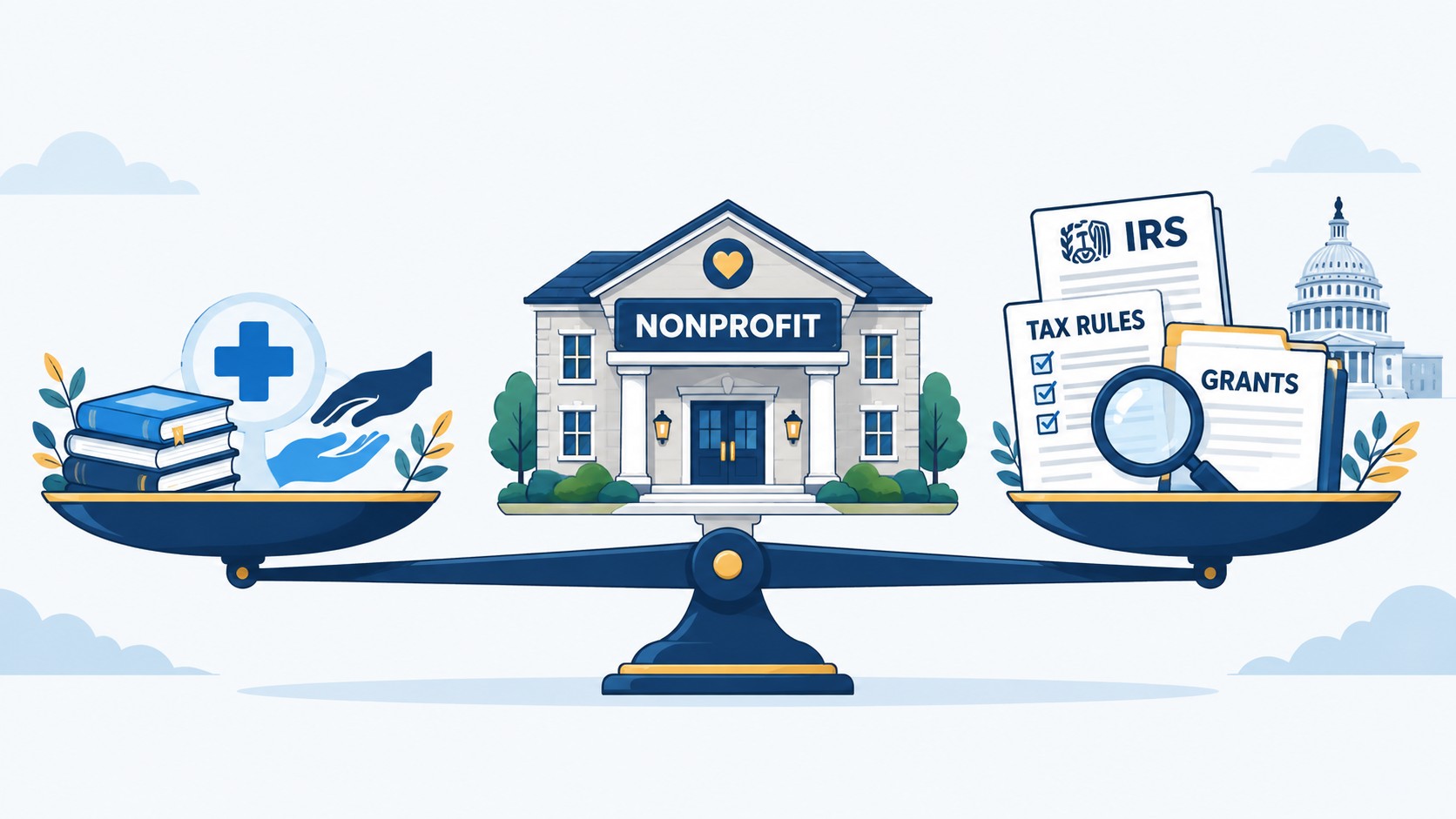
Why hospitals, universities and other nonprofits face growing federal scrutiny
Universities, hospitals and other nonprofit institutions provide education, health care, research and community services that benefit the public. In exchange, qualifying Section 501(c)(3) organizations generally do not pay federal income tax on mission-related income, and their donors may receive charitable deductions. Depending on state and local law, they may also receive property-tax and sales-tax exemptions and access to tax-exempt financing.
These benefits can be substantial. Some exempt universities and hospital systems own billions of dollars in buildings and investments, earn large operating surpluses and pay executives compensation comparable to major corporations. That has intensified an old policy question: when does a charitable organization become so commercial that taxpayers should no longer subsidize it?
Nonprofit Does Not Mean No Profit
A nonprofit may charge tuition or patient fees, earn investment income and end the year with revenue exceeding expenses. The critical difference is that it has no shareholders entitled to receive the profits. Its earnings and assets must remain dedicated to exempt purposes, and no part of its net earnings may improperly benefit insiders.
Nonprofits may also pay reasonable compensation for services actually performed. High compensation is not automatically prohibited, particularly at a large hospital system or university, but the amount should be independently approved, supported by comparable-market data and documented. Excessive compensation or other benefits provided to insiders may trigger the Section 4958 excess-benefit rules, while Section 4960 can impose an excise tax on certain compensation exceeding $1 million.
Not every revenue-producing activity is tax-free. A nonprofit that regularly operates a business not substantially related to its exempt purpose may have unrelated business taxable income (UBTI), potentially requiring Form 990-T and payment of tax. Examples may include recurring advertising, commercial merchandise sales, certain gaming, or service fees. Simply using the proceeds for a charitable mission does not by itself make the income exempt.
Tax exemption is therefore better understood as a public-benefit bargain—not a permanent entitlement. The organization must continue operating for exempt purposes, avoid impermissible private benefit, comply with filing requirements and observe limits on lobbying and political activity. Charitable hospitals also face Section 501(r) requirements involving community health assessments, financial-assistance policies, billing and collection practices.
Washington’s Revenue Debate
A March 2026 Washington Post opinion argued that the nonprofit sector has become a potential source of revenue for reducing federal deficits. The analysis behind the article estimated that tax-exempt organizations generated approximately $2.8 trillion of program-service and other business-related income in 2023 and suggested that taxing the associated net business income at the 21% corporate rate could raise about $51 billion annually.
Those numbers represent a policy estimate—not an official congressional revenue score. Current law already taxes regularly conducted business activities that are not substantially related to an organization’s exempt purpose through the unrelated business income tax rules. The broader and more difficult question is whether tuition, patient-care receipts and similar mission-related revenue should remain exempt when large nonprofits compete with taxable businesses. Potential reforms could include stronger public-benefit standards, greater disclosure and targeted taxation of commercial activities rather than treating every nonprofit receipt as corporate income.
Federal Pressure Points
The friction between the Trump administration and parts of the nonprofit sector currently extends beyond the ordinary IRS examination process:
-
DEI and race-based programs. Treasury and the IRS have proposed denying Section 501(c)(3) status to private K–12 schools, colleges, universities and trade schools that use race, color, or national or ethnic origin in admissions, scholarships, athletics or other school-supported programs—even when the policy is described as remedial or diversity-oriented. Race-neutral criteria such as income, geography, first-generation status and individual hardship would remain permissible.
-
Greater control over federal grants. OMB and more than 40 agencies proposed revisions to the federal Uniform Guidance that would require discretionary grants to advance presidential priorities, increase review by senior political appointees and broaden agencies’ ability to suspend or terminate awards that no longer advance current agency priorities or the national interest. Congress has temporarily delayed implementation, but the proposal illustrates the increased political and compliance risk facing federally funded nonprofits.
-
Investigations and exemption threats. National Security Presidential Memorandum 7 directs federal agencies to investigate organizations, funders and individuals allegedly connected to political violence and instructs the IRS to ensure exempt entities are not directly or indirectly financing such activity. President Trump also publicly threatened Harvard’s exemption and said the government was reviewing Citizens for Responsibility and Ethics in Washington. However, a president cannot unilaterally revoke an organization’s status or direct the IRS to begin or end a particular tax investigation; the IRS must follow its statutory examination and administrative procedures.
-
Direct reductions in federal funding. An analysis of federal grant data reported that grants to non-hospital, non-university charities fell from $35.4 billion to $21.4 billion—nearly 41%—during February through September 2025 compared with the corresponding 2024 period. The administration’s FY 2026 budget also proposed major reductions or eliminations affecting housing, environmental justice, community development, research, health and other programs frequently delivered through nonprofit organizations.
September 2026 IRS Proposal
On September 3, 2026, Treasury and the IRS released proposed Regulation Section 1.501(c)(3)-2. A private school would not be considered operated exclusively for exempt purposes if it maintains or enforces a policy or practice that discriminates based on race, color, or national or ethnic origin. Treasury estimates that as many as 18,000 exempt educational institutions could be affected.
Ed Zollars, CPA, explains that the proposal would codify the public-policy doctrine associated with Brown v. Board of Education, Bob Jones University v. United States and Students for Fair Admissions v. Harvard. It would also remove provisions of Revenue Procedure 75-50 that currently protect certain race-conscious admissions and financial-aid programs intended to promote nondiscrimination. The proposal does not authorize interim reliance and is not yet final. If finalized as proposed, it would apply to taxable years beginning after May 31, 2027, allowing schools time to review admissions, scholarships, athletics and donor-restricted programs.
Revocation Is Real
The IRS publishes a list of organizations whose Section 501(c)(3) determinations have been revoked. Revocation may occur when an organization no longer operates primarily for exempt purposes, allows prohibited private benefit, violates political-activity restrictions or acts contrary to fundamental public policy. Separately, failing to file a required Form 990-series return or notice for three consecutive years results in automatic revocation.
For boards and management, the practical message is straightforward: exemption must be continuously earned. Organizations should document reasonable compensation, measure public benefits, review commercial revenue and property use, maintain Form 990 compliance and monitor federal grant conditions. Private schools should promptly inventory admissions, scholarship, athletic and support programs that expressly or indirectly use race-based criteria, while coordinating changes with tax and legal counsel.
