

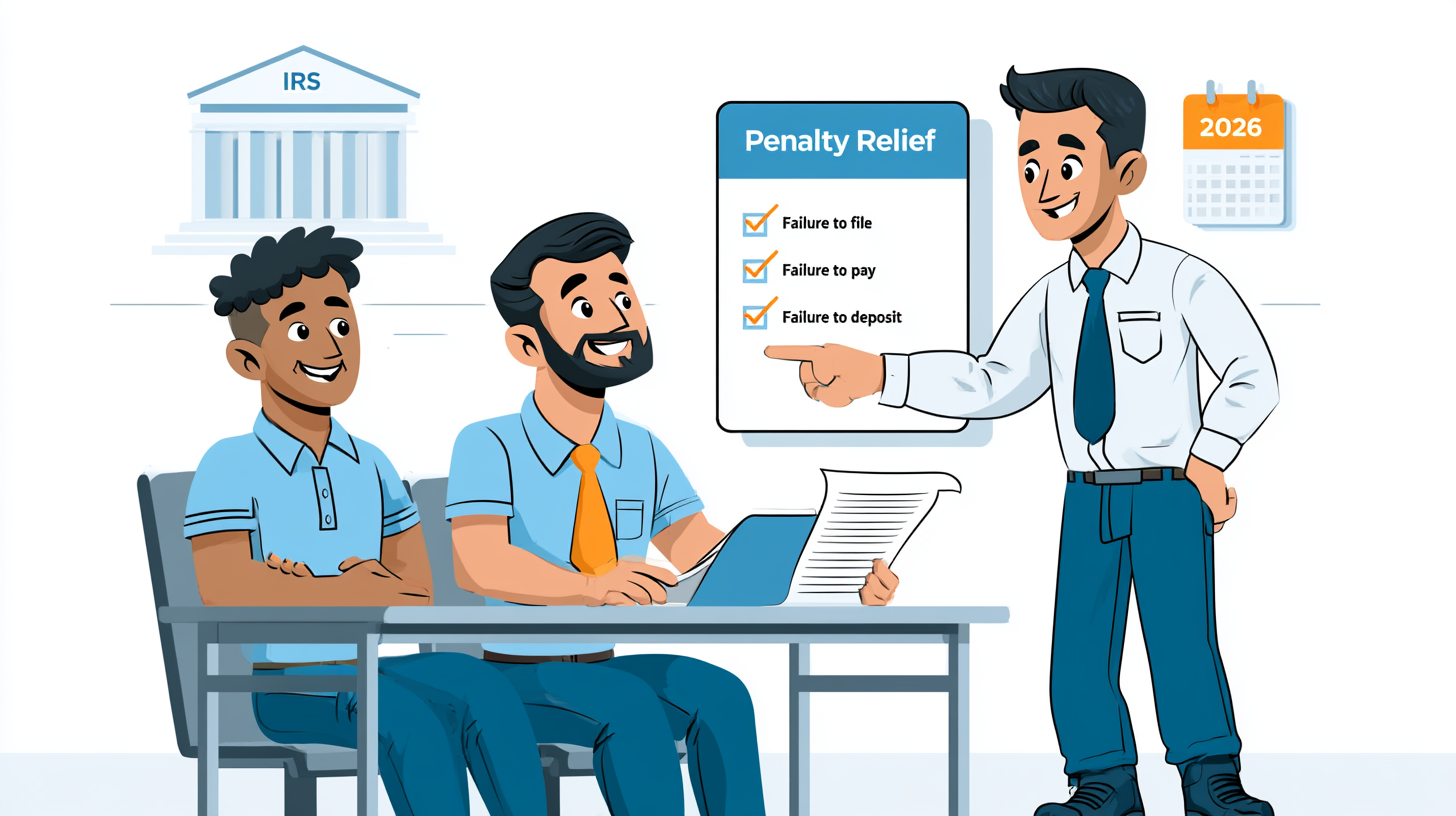
The IRS’s new Automatic Exemption from Penalty (AEP) is meant to help “good” taxpayers—but it also takes away some useful flexibility and control that we’ve had under First‑Time Abatement (FTA).
What AEP does, in plain English
Starting with 2025 returns and 2026 quarterly payroll returns, the IRS will automatically skip certain penalties—failure to file, failure to pay, and failure to deposit—if you have a solid three‑year history of filing and paying on time (or 12 straight quarters for payroll taxes). You don’t have to ask, fill out forms, or call anyone; the system quietly blocks the penalty and sends you a notice saying relief was granted.
That’s a big change from FTA, where the IRS would first assess the penalty and then remove it only after you or your CPA or other tax professional requested relief.
Concern #1: Losing the ability to strategically use penalty relief
Under the previous First-Time Abate (FTA) process, taxpayers and their representatives often requested relief for the year that provided the greatest financial benefit—typically the year with the largest penalties and the most accrued interest. While the IRS ultimately determined eligibility, there was generally an opportunity to request relief for the year that made the most sense. Under the new Automatic Exemption from Penalty (AEP) process, the IRS system determines when the relief is applied. As a result, taxpayers may lose the ability to strategically preserve that one-time relief for a future year with more significant penalties.
Concern #2: Using your “get out of jail free” card when another solution may have resolved the penalty
Another potential concern is how AEP will interact with situations in which a penalty is assessed because the IRS’s records are incomplete or another form of relief may ultimately apply. For example, a taxpayer may receive a late-filing penalty notice even though a timely extension was mailed and can later be substantiated with a certified mail receipt. After the taxpayer or representative provides the proof, the IRS may locate or verify the extension and determine that the penalty should never have been assessed. Likewise, there may be cases where a taxpayer qualifies for reasonable cause relief. It remains unclear whether, in these types of situations, the IRS’s automatic application of AEP could inadvertently consume the taxpayer’s one-time automatic penalty relief. As additional guidance is issued and the program matures, practitioners will be watching closely to see how the IRS administers these situations.
Who qualifies, especially for businesses
To qualify for AEP, you generally need:
-
Timely filing and paying for the same type of return over the prior three years (or 12 quarters for payroll returns)
-
For businesses, no more than three prior waivers of failure‑to‑deposit penalties in that time
-
The penalty cannot be tied to avoiding use of the Electronic Federal Tax Payment System (EFTPS)
If you don’t qualify, you can still request penalty relief based on reasonable cause—things like serious illness, natural disasters, or other circumstances the IRS will review case by case.
What this means for you
Automatic relief is convenient and will help many taxpayers without paperwork or phone calls. But because it’s built into the IRS’s systems, it can also:
-
Use relief in a year you wouldn’t have chosen
-
Reduce your flexibility if you have issues in more than one year
Our practical advice: if you get a penalty notice—especially for payroll or multiple years—talk with your CPA before you respond, so you don’t accidentally use up relief that might be more valuable later.
