

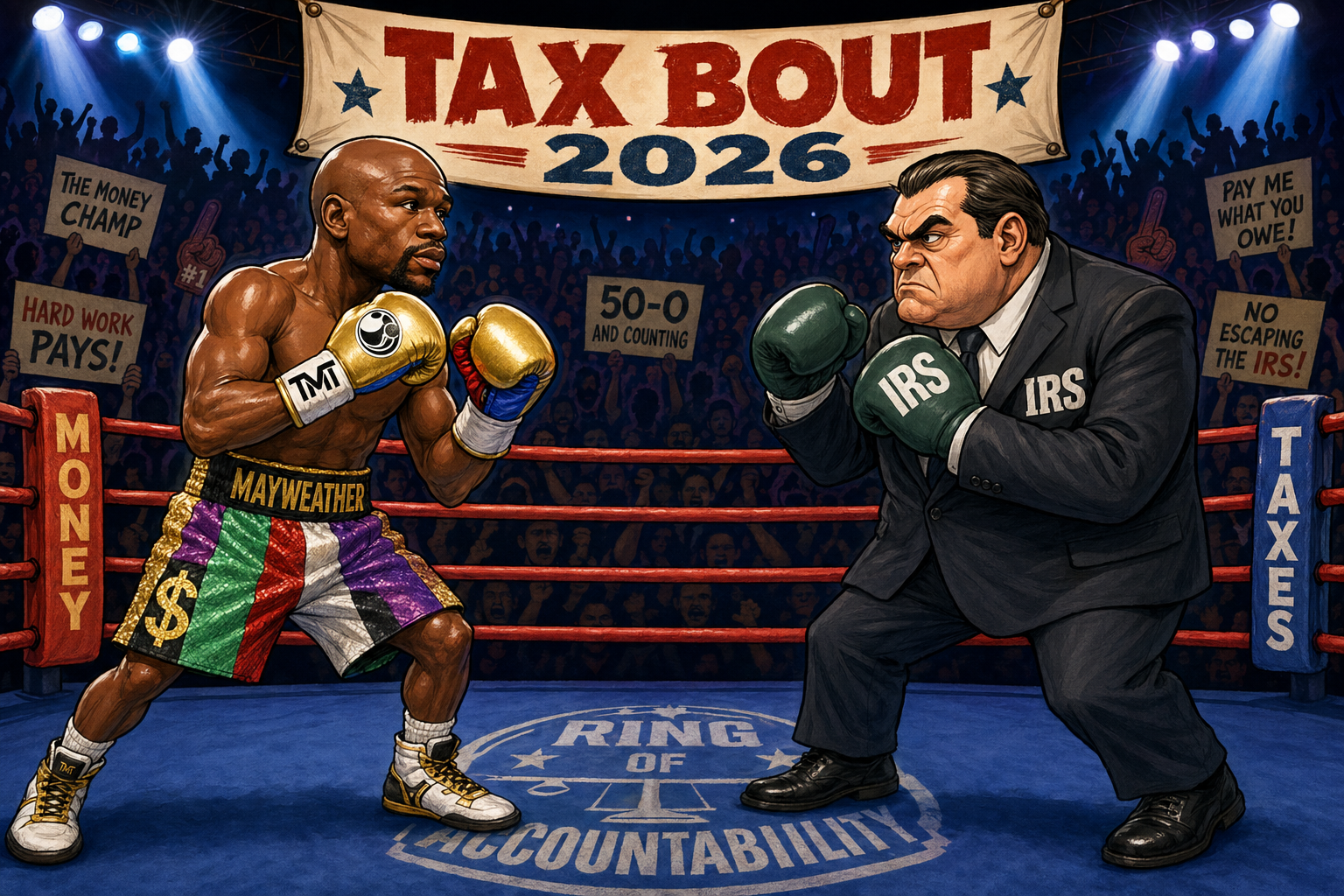
Floyd “Money” Mayweather’s IRS Problem: When Wealth Doesn’t Equal Cash
Floyd Mayweather Jr., the undefeated boxing champion who earned an estimated $1.15 billion during his career, has been locked in a decades-long battle with the Internal Revenue Service. Despite his “Money” nickname and lavish lifestyle, Mayweather’s financial saga reveals a critical lesson for wealthy taxpayers: substantial assets don’t excuse unpaid taxes when those assets are tied up and can’t be easily converted to cash.
A Pattern of Tax Liens Dating Back to 2001
Mayweather’s tax troubles aren’t new—they represent a recurring cycle spanning over two decades. The boxer paid $15.5 million in taxes for the years 2001, 2003-2007, and 2009 only after the IRS filed liens against him, establishing a pattern where payment came only after government enforcement action. Additional liens followed for 2010 ($7.2 million) and 2015 ($22.2 million), with each case demonstrating the same issue: Mayweather possessed enormous wealth but struggled to access liquid funds to satisfy his tax obligations.
The 2017 Tax Court Petition: Illiquid Assets and Fight Purses
The most revealing chapter in Mayweather’s tax saga came in 2017, when he owed $22.2 million for his 2015 taxes—the year he earned approximately $200 million fighting Manny Pacquiao. On July 5, Mayweather filed a petition with the U.S. Tax Court requesting a temporary reprieve from the IRS, arguing that while he had substantial assets, they were “restricted and primarily illiquid,” according to court filings cited by Law360. The petition explained that Mayweather expected a major liquidity event—his fight purse from the upcoming Conor McGregor bout—within roughly 60 days, at which point he intended to pay the outstanding balance in full.
The IRS had refused Mayweather’s direct request to pay in installments until after the McGregor fight, and the agency indicated its intention to levy his assets. His legal team’s argument highlighted a fundamental problem: despite owning valuable real estate, investments, and luxury items worth hundreds of millions, Mayweather couldn’t immediately access enough cash to satisfy the tax bill. The failure-to-pay penalty—typically 0.5 percent per month—had already added significant charges to his balance, with his 2015 taxes being 15 months past due at the time, equaling a 7.5 percent penalty on top of the principal amount owed.
The 2017 and Recent Tax Court Rulings
In 2023, a U.S. Tax Court judge ordered Mayweather to pay $5.5 million in tax deficiencies plus $1.1 million in penalties related to his 2017 taxes. The case stemmed from a disallowed $14 million deduction for legal expenses claimed through Mayweather Promotions, demonstrating that his tax issues extended beyond simply failing to pay—they also involved aggressive deductions that didn’t withstand IRS scrutiny.
The Latest Lien: $7.3 Million for 2018 and 2023
On March 26, 2026, the IRS officially filed a federal tax lien against Mayweather in Clark County, Nevada, for $7.3 million in unpaid taxes from 2018 and 2023. As of the filing date, the IRS listed the amount as completely unpaid, giving the agency a legal claim on Mayweather’s Las Vegas property and potentially other assets until the debt is settled. This latest lien represents a continuation of the same pattern that has defined Mayweather’s relationship with the IRS for over 20 years.
The Illiquid Wealth Paradox
Mayweather’s situation illustrates a critical tax principle that many wealthy individuals face: the IRS doesn’t care how your assets are structured—taxes must be paid in cash, on time. While Mayweather owns extensive real estate holdings, luxury cars, jewelry, and other high-value assets, these investments don’t generate the immediate liquidity needed to satisfy large tax bills. His team has consistently cited “illiquid assets” as the reason for delayed payments, requesting extensions until a “liquidity event” (typically a major fight purse) provides the necessary cash flow.
Despite earning over $1 billion throughout his Hall of Fame career, Mayweather’s financial position demonstrates that wealth management requires more than just accumulating valuable assets—it demands strategic liquidity planning to meet ongoing tax obligations. As his attorney declined to comment on the latest $7.3 million lien, the pattern that began in 2001 continues, with the IRS once again pursuing “Money” Mayweather for unpaid taxes.
However, a potential solution may be on the horizon. Reports suggest a possible rematch against Manny Pacquiao scheduled for Netflix in September 2026, which could provide the major liquidity event Mayweather needs to settle his outstanding tax debt and address other financial obligations. Just as Mayweather relied on his 2017 McGregor fight purse to resolve that year’s tax crisis, the Pacquiao rematch could serve as the cash infusion necessary to clear his current IRS balance and restructure his debt-laden asset portfolio. Whether this fight materializes—and whether Mayweather finally breaks the two-decade cycle of tax liens followed by last-minute settlements—remains to be seen.
Business Insider Link – IRS seeks $7.3 million from Floyd Mayweather
Yahoo Sports Link – Floyd Mayweather slammed with $7.3 million IRS lien over unpaid taxes claim
